
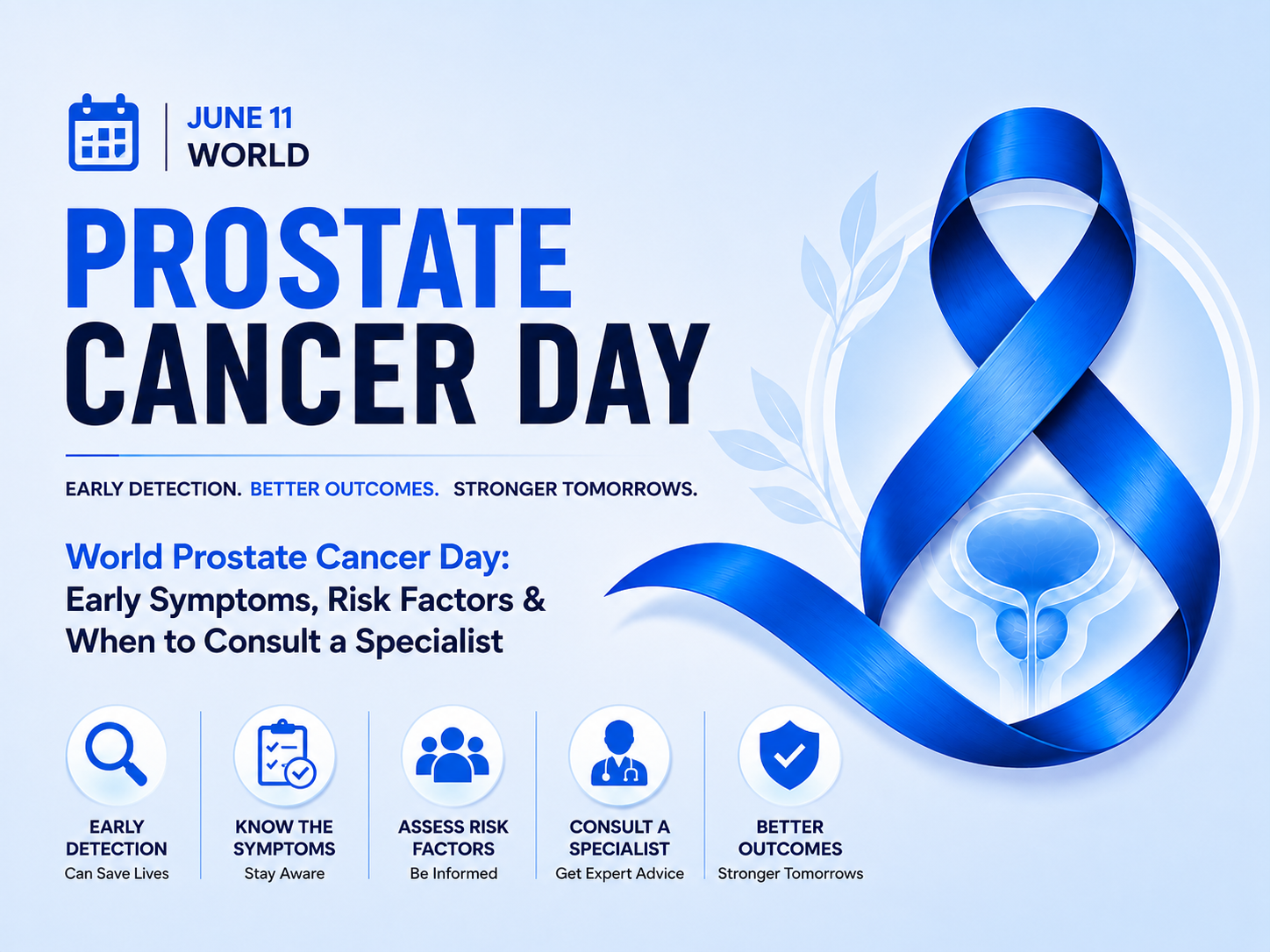
World Prostate Cancer Day: Early Symptoms, Risk Factors & When to Consult a Specialist
What is Prostate Cancer?
The prostate is a small gland located below the bladder in men. Prostate cancer occurs when abnormal cells in the prostate begin to grow uncontrollably. In many cases, prostate cancer develops slowly, but some forms can be aggressive and spread to other parts of the body.
Early Symptoms of Prostate Cancer
Many men may not experience symptoms during the early stages. However, warning signs may include:
- Frequent urination, especially at night
- Weak or slow urinary stream
- Difficulty starting or stopping urination
- Blood in urine or semen
- Pain or discomfort in the lower back, hips, or pelvis
- A feeling of incomplete bladder emptying
If you experience any of these symptoms, it is important to seek medical evaluation promptly.
Risk Factors
Several factors can increase the risk of prostate cancer:
Age
The risk increases significantly after the age of 50.
Family History
Men with a family history of prostate cancer are at a higher risk.
Lifestyle Factors
Obesity, poor diet, and lack of physical activity may contribute to increased risk.
Genetic Factors
Certain inherited gene mutations can increase susceptibility.
Positively impacted through surgical oncology care.
Importance of Early Detection
Early detection plays a crucial role in successful treatment. Regular health check-ups and screening tests can help identify prostate cancer before symptoms become severe.
Benefits of early detection include:
- Better treatment outcomes
- Higher survival rates
- More treatment options
- Improved quality of life
Diagnosis of Prostate Cancer
- PSA (Prostate-Specific Antigen) Blood Test
- Digital Rectal Examination (DRE)
- MRI Scan
- Prostate Biopsy
Treatment Options
Treatment depends on the stage and severity of the cancer. Options may include:
Active Surveillance
Suitable for slow-growing cancers with low risk.
Surgery
Removal of the prostate gland may be recommended in certain cases.
Radiation Therapy
Uses high-energy rays to destroy cancer cells.
Hormone Therapy
Helps reduce the growth of cancer by lowering hormone levels.
Advanced Cancer Treatments
Modern approaches such as robotic surgery and targeted therapies can improve outcomes for selected patients.
When Should You Consult a Specialist?
You should consult a cancer specialist if you experience:
- Persistent urinary symptoms
- Blood in urine or semen
- Unexplained pelvic or back pain
- Family history of prostate cancer
- Elevated PSA levels
Early consultation can help ensure timely diagnosis and treatment.
Expert Surgery. Personalized Cancer Care.
Precision Surgery Backed by Compassionate Care
Specialized care for Every Stage of Cancer
Connect with a trusted surgical oncologist for precise cancer diagnosis and advanced treatment options tailored to your needs.
Consult Dr. Rahul Sandhu?
Dr. (Lt. Col.) Rahul Sandhu is a Senior Consultant – Surgical Oncology with extensive experience in advanced cancer surgeries and comprehensive cancer care.
📞 Appointment: 98889 70519
Conclusion
Prostate cancer is treatable, especially when detected early. Understanding the symptoms and risk factors can help men take proactive steps toward better health. This World Prostate Cancer Day, spread awareness and encourage regular health screenings.
Early Detection. Better Outcomes. Stronger Tomorrows.
Patient Experiences & Success Stories
Read heartfelt experiences from our patients who trusted us with their cancer care and found hope, healing, and expert treatment.
EXCELLENTTrustindex verifies that the original source of the review is Google. I had a very positive experience. The doctor was kind, patient, and truly cared about my recovery. The treatment and guidance were excellent. Thank you for the great care.Posted onTrustindex verifies that the original source of the review is Google. Excellent experiencePosted onTrustindex verifies that the original source of the review is Google. I traveled all the way from Canada to see Dr. Rahul Sandhu for keloid treatment, and it was the best decision I could have made. After struggling with keloids for a long time, I was looking for a non-surgical solution. Dr. Rahul sandhu provided an incredible injection-based treatment that has given me the best results I’ve ever had. Beyond his medical expertise, he is exceptionally nice, calm, and supportive. He took the time to listen to my concerns and made me feel completely at ease throughout the entire process. If you are looking for effective, non-surgical keloid care from a doctor who truly cares about his patients, than go for it . HE IS BEST DOCTOR I HAVE EVER SEEN ❤️.Thankyou so much DR RAHUL SANDHU🙏🏻Posted onTrustindex verifies that the original source of the review is Google. Would take a moment to appreciate Dr. Sandhu for being an amazing surgeon. We are extremely grateful for the excellent care given to my mother during her kidney surgery. He explained everything clearly, handled the surgery with great expertise, and ensured smooth recovery. Very humble, patient, and approachable. Highly recommended.Posted onTrustindex verifies that the original source of the review is Google. Excellent workPosted onTrustindex verifies that the original source of the review is Google. I am very satisfied with dr Rahul Sandu treatment. He is very nice and polite Nursing team also very efficientPosted onTrustindex verifies that the original source of the review is Google. My mother was suffering from UTI and gallbladder swelling. She was in a great pain. We went to meet Dr Rahul Sandhu an Onco Specialist at Clear Medi Hospital. The way Dr Rahul Sandhu handled the case I am truly grateful for the care and support provided by Dr. Rahul Sandhu during the treatment. From the very first consultation, he made sure to explain the diagnosis clearly and guided us step-by-step through the entire process. Their expertise, compassionate approach, and attention to detail gave us great confidence and hope. Dr Rahul Sandhu always listened very patiently to our concerns and answered all our questions whether it is a personal meeting or over phone call. The treatment was handled with utmost professionalism, and the follow-ups were timely and thorough. I am really thankful to his dedication and felt well-supported by him both medically and emotionally through this tough time. He is really a great doctor and a very humble person too. I highly appreciate Dr.Rahul Sandhu (Oncologist) and their entire medical team for their kindness, commitment, and excellent care. I would strongly recommend if anyone is suffering from such illness he/she must visit to him once for a knowledgeable and caring support. Thank you So much Dr Rahul Sandhu for your kind support.Posted onTrustindex verifies that the original source of the review is Google. I feel very professional and doctor has complete ethics , he treated patient very nicely .Posted onTrustindex verifies that the original source of the review is Google. I was referred to Dr. Rahul Sandhu by a close friend when my mother’s condition worsened after receiving cancer treatment at TMC. From the very first meeting, Dr. Sandhu’s positivity and compassion gave us a sense of hope that we had been desperately looking for. He is not just a highly skilled Surgical Oncologist and Lieutenant Colonel, but also an incredibly down-to-earth, gentle, and sophisticated human being. What truly sets him apart is the time he gives to his patients. He explained every step of the treatment clearly, answered all our questions with patience, and made sure we never felt rushed or ignored. In moments of confusion and fear, he became a beacon of clarity and reassurance. Good doctors like him replace the fear of illness with trust in recovery. His caring nature, dedication, and genuine concern for his patients’ well-being make him a true asset to the medical community. Credit goes to his upbringing, values, and the teachers who shaped him into the remarkable doctor he is today. My mother received not just treatment, but comfort, positivity, and real hope under his care. I am deeply grateful for everything he has done for us. To anyone reading this — if you get a chance to meet Dr. Rahul Sandhu, you will experience what a truly good human being and exemplary doctor he is. Thank you so much, Dr. Rahul Sandhu. I truly hope you keep this spirit alive throughout your life.Posted onTrustindex verifies that the original source of the review is Google. Hie.. everyone.. I had first surgery of my life that is gallbladder removal surgery..I was really scared and anxious about it like wht will happen or.. like a strange feeling in my mind .. but after having a appointment with my surgeon Dr.Rahul Sandhu he comforts me like a friend ..he's empathetic, an active listener, and an excellent communicator who provides thorough explanations and a clear plan of action.. A good doctor makes you feel heard acknowledged..and like a priority... He provide clear explanations of diagnoses treatment options.. risks and benefits. He don't always agree but will offer thoughtful counterpoints and discuss alternatives.. rather than ..dismissing your ideas.. he'll guild you to best advice for treatment if you needed..I am very lucky that I got my laproscopic surgery done by him a month ago ... Now I am completely fine. It did not even feel like I had surgery... do consult with him for your better health.. 💗😊